








By Daniela F. Henriques, Esq.
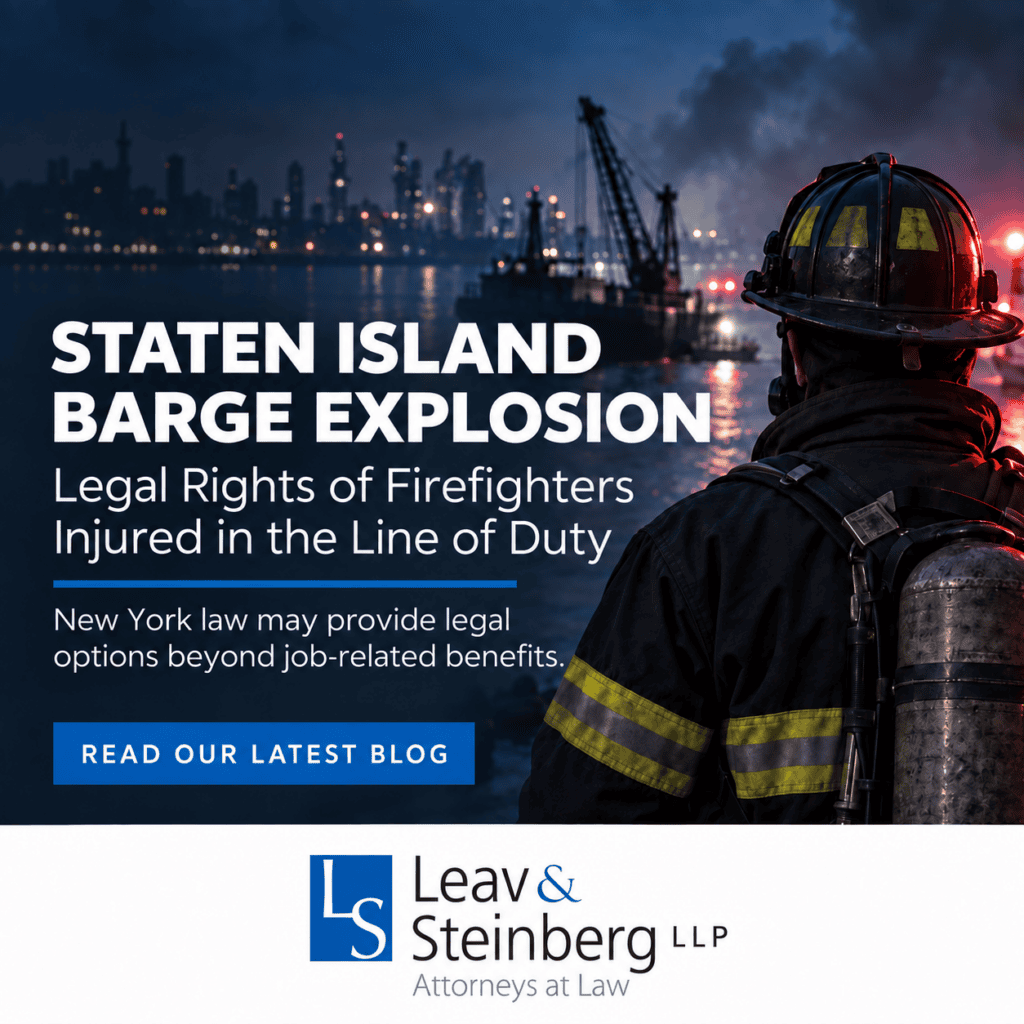
A New York City firefighter injured while responding to a fire, explosion, unsafe building, roadway hazard or other emergency may have legal rights beyond job related benefits. When someone other than the firefighter’s employer or co-worker contributed to the injury, New York General Obligations Law § 11-106 may permit a negligence claim. General Municipal Law § 205-a may also provide a claim when a violation of a statute, ordinance, rule, order, or government requirement directly or indirectly caused the injury. The facts and deadlines must be investigated promptly.
On September 10, 2026, an explosion aboard a petroleum barge in Mariners Harbor, Staten Island, killed one worker and caused a major fire inside a shipping container. News reports stated that two firefighters sustained injuries and that approximately 160 fire, EMS, and Hazmat personnel responded. The cause of the explosion remained under investigation in the initial reporting.
The incident is another reminder that firefighters do not face danger only from flames. Explosive vapors, improperly stored chemicals, defective equipment, unsafe premises, code violations, concealed structural hazards, and failures to warn can turn an emergency response into a preventable catastrophe.
Leav & Steinberg LLP represents injured people throughout New York City, including Manhattan, the Bronx, Brooklyn, Queens, and Staten Island. Our attorneys investigate whether a property owner, contractor, vessel operator, manufacturer, maintenance company, or other third party bears legal responsibility for an injury.
New York General Obligations Law § 11-106 permits a firefighter injured in the line of duty to seek damages when the injury was proximately caused by the neglect, willful omission, or other culpable conduct of a person or entity other than the firefighter’s employer or co-employee.
This means that an injured firefighter’s case may involve a claim against a negligent third-party such as:
- A property owner or commercial tenant that allowed a dangerous condition to exist;
- A vessel owner or operator;
- A contractor or subcontractor responsible for unsafe work;
- A company that improperly stored fuel, chemicals, paint, or explosive materials;
- A manufacturer or distributor of defective equipment;
- A maintenance or inspection company that failed to identify or correct a hazard; or
- A driver or other person whose negligence caused an emergency-response collision.
New York General Municipal Law § 205-a creates an additional right of action for firefighters whose injury or death results directly or indirectly from a person’s failure to comply with a federal, state, or local statute, ordinance, rule, order, or governmental requirement.
In practical terms, a § 205-a investigation may examine whether the responsible party violated a specific safety requirement involving:
- Fire prevention and building safety;
- Hazardous or flammable materials;
- Workplace safety;
- Electrical systems;
- Structural integrity;
- Means of entrance and exit;
- Machinery or pressure systems;
- Warning signs, labeling, or emergency plans; or
- Vessel and waterfront operations.
New York courts describe the violated statute, ordinance, rule, order, or governmental requirement as the “statutory predicate” for a General Municipal Law § 205-a claim. An injured firefighter must identify the applicable safety provision, describe how the line-of-duty injury occurred, and present facts from which it can be inferred that the defendant’s negligent noncompliance directly or indirectly caused the harm.
The required connection is sometimes described as a “practical or reasonable connection” between the safety violation and the firefighter’s injury. A firefighter pursuing a § 205-a claim is not necessarily required to establish the same degree of proximate causation required in an ordinary common-law negligence action.
Potential statutory predicates may include provisions of the New York City Fire Code, New York City Building Code, Multiple Dwelling Law, Labor Law, OSHA regulations, hazardous-material requirements, electrical-safety rules, or other federal, state, and local safety provisions. The applicable predicate depends on the location, hazard, responsible parties, and precise manner in which the firefighter was injured.
That is why an investigation should not stop with the cause of the initial fire. It should also determine whether explosive vapors, combustible materials, defective equipment, unsafe stairs, obstructed exits, structural hazards, missing warnings, improper storage, inadequate ventilation, or other code violations increased the danger encountered by responding firefighters.
New York’s Legislature enacted General Obligations Law § 11-106 to permit negligence claims against responsible third parties, while excluding claims under that statute against the firefighter’s employer or co-employee. Section 205-a separately addresses injuries connected to violations of statutes, ordinances, rules, orders, and governmental requirements.
Leav & Steinberg LLP has decades of experience investigating serious personal injury matters in New York. The firm’s work has included claims involving municipal hazards and injured first responders. In one published discussion, partner Daniela F. Henriques explained the firm’s investigative use of Freedom of Information Law requests in matters involving dangerous New York City roadway and sidewalk conditions, including the challenges presented by a line-of-duty injury to an NYC firefighter. Read more about the firm’s investigative approach.
Speak With a New York Firefighter Injury Lawyer: If you are an FDNY member, firefighter, fire marshal, or other first responder who was injured because of a dangerous property condition, explosion, defective product, unsafe work practice, roadway defect, or another party’s negligence, Leav & Steinberg LLP can evaluate the potential claims. Call 212-766-5222 for a free consultation. The firm represents injured clients throughout New York City and the surrounding counties. No legal fee is owed unless the firm obtains a recovery.